If you’ve ever shopped for forklift solid tires, you know the first question that pops up isn’t usually “what material are these made of?” or “how long will they last?”—it’s “how much will this set cost?” As a forklift solid tire supplier who’s spent the last decade talking to warehouse managers, fleet owners, and small business operators, I get it. Forklift downtime doesn’t wait for a budget, and choosing the wrong tire can eat into your profits faster than a forklift moving pallets at full tilt. Let me break down the real price ranges for solid forklift tires, what factors change that number, and how to make sure you’re not overpaying or underspending. Forklift Solid Tire
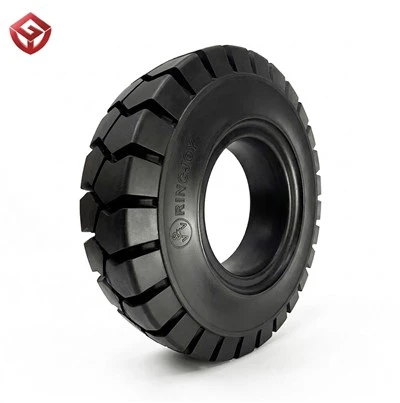
First, let’s clear up a common misconception: solid forklift tires aren’t a one-size-fits-all product. They’re built for specific forklift types, load capacities, and work environments, and those variables directly impact their price. I’ve seen customers walk in expecting to pay $100 for a single front tire, only to find out their 12,000 lb. capacity rough-terrain forklift needs tires that cost three times that. That’s the kind of surprise that messes up a weekly budget, so let’s start with the basics. The price range for solid forklift tires today runs roughly from $80 per single tire on the low end, all the way up to $800 or more per tire on the high end. But that’s a broad number—let’s get specific, because that’s where the real value lives.
At the lower end of the spectrum, you’ll find what we call “economy solid tires.” These are built for small, light-duty forklifts—think the 3,000 to 5,000 lb. capacity sit-down forklifts you see in small retail warehouses, or the order pickers that move single pallets of office supplies. They’re made with a standard rubber compound, no reinforced layers, and they’re designed for light, indoor use on smooth concrete. For these, a single front solid tire will run you between $80 and $150, and a set of four drive tires will come in around $250 to $400. I’ve had a few customers who own small family-owned distribution businesses go with these because they only run their forklift 20 hours a week, and they’re willing to replace tires every 18 to 24 months instead of paying more upfront. The catch here is that these tires don’t hold up to sharp objects, heavy loads, or abrasive surfaces like asphalt well. If you’re running over a loose nail or a piece of broken glass, these tires can puncture even though they’re solid—something I always warn my economy customers about.
Moving up to the mid-range, that’s where most of our regular customers land. These are the standard solid tires built for 6,000 to 10,000 lb. capacity forklifts, which are the workhorses of most manufacturing plants, large distribution centers, and construction sites. The mid-range tires have a reinforced nylon cord body, a thicker rubber tread, and a compound that balances grip and durability for both indoor concrete and light outdoor asphalt use. A single front tire here will cost between $150 and $350, and a full set of four drive tires ranges from $400 to $1,000. What makes this range worth it, in my experience, is the lifespan. Most mid-range tires last three to five years with regular maintenance, and they’re far less prone to punctures from small debris than economy tires. Last year, a food distribution client of mine ran 10,000 hours on a set of mid-range tires without a single blowout—something they couldn’t say about the economy tires they’d used before. That consistency means less downtime, which is worth the extra investment for most operations. I always tell customers that if their forklift runs 40 hours a week or more, this is the sweet spot.
Then there’s the high-end tier, which starts around $350 per single tire and can go well over $800, depending on the specifications. These aren’t your average off-the-shelf tires. High-end solid tires are built for heavy-duty, extreme environments: 12,000 lb. to 36,000 lb. capacity forklifts used in steel mills, ports, or scrap yards, or forklifts that run 24/7 through frozen warehouses, grain silos, or areas with sharp, abrasive debris. The rubber compounds here are specialized—some are heat-resistant for foundry use, others are cut-resistant for scrap handling, and some have extra deep treads for rough terrain. They also have multiple reinforced cord layers to support heavy loads without flexing. I recently worked with a port logistics company that needed tires for their container-handling forklifts; their high-end solid tires cost $950 each, but they only replace them every six to seven years, compared to the $500 mid-range tires that needed replacement every two years. For operations where forklift downtime can cost thousands of dollars an hour, that long lifespan and durability make the high-end price tag worth it.
Now, let’s talk about the hidden factors that can make a tire’s price jump or drop, because that’s where a lot of customers get tripped up. The first is size—this might sound obvious, but a tire’s diameter and width play a huge role. A small front tire for a 3,000 lb. order picker is 18 inches tall and 7 inches wide, while a drive tire for a 36,000 lb. rough-terrain forklift is 36 inches tall and 15 inches wide. The larger the tire, more rubber and material go into it, so the price goes up. I had a customer last year who ordered the wrong size tire for their heavy forklift; they thought size was just about fitting the rim, but a 30-inch tire costs $200 more than a 24-inch one, even if the rim size is the same. That’s a mistake I always emphasize getting right before ordering.
The second big factor is the type of solid tire itself. Wait, not all solid tires are the same—there’s cushion solid tires, which are the standard for indoor forklifts, and press-on solid tires, which are used for larger, heavier forklifts that need to fit over a steel press-on rim. Press-on tires tend to be more expensive, because they’re thicker and designed to handle more weight, but they also don’t slip on the rim like cushion tires can. I once had a customer who switched from cushion to press-on tires and reduced their tire-related service calls by 70%—even though the initial price was higher, they saved money on labor and downtime.
Third, is the work environment. If your forklift is mostly on smooth, indoor concrete, you can go for a lighter, more affordable tire. But if you’re working on rough asphalt, gravel, or a floor with a lot of sharp debris, you need a tire with a tougher compound and thicker tread. Last quarter, a landscaping company came to me for tires for their yard forklift, which runs on uneven gravel and gets nails and glass in its path; the economy tire they bought before only lasted three months, so they went with a mid-range cut-resistant tire that lasted 18 months. The extra $100 per tire upfront saved them from replacing tires every few months.
Another hidden cost is what’s called “recycled solid tires.” A lot of suppliers will sell tires made from retreaded or mixed rubber at a lower price, sometimes as low as $50 per tire. But I never recommend these. Retreaded solid tires have a thin layer of new rubber over an old, worn base, so they’re prone to blowouts and have a much shorter lifespan. I once saw a client go with recycled tires because they were 30% cheaper, and in six months, they had three blowouts that cost them $2,000 in lost production and repairs. The upfront savings aren’t worth the risk, and that’s something I always be honest about with customers.
Now, I know what some of you are thinking: “How do I know which price range is right for my operation?” Here’s what I tell every customer who calls me: start with two numbers. First, the average hours your forklift runs per week. If it’s 20 hours or less, economy tires might work for you, as long as your environment is smooth and light. If it’s 20 to 40 hours a week, mid-range is the sweet spot for most small to medium operations. If it’s more than 40 hours a week, or you’re working in an extreme environment, high-end is the way to go. Second, calculate the total cost of ownership, not just the upfront price. A $150 tire that lasts two years is $6.25 per month, while a $300 tire that lasts five years is $5 per month—so the more expensive one is actually cheaper in the long run.
As a supplier, I don’t push the most expensive tire on every customer. I look at their specific needs, their budget, and how they use their forklift to help them make the best choice. Last month, I worked with a startup e-commerce company that had a tight budget for their two small order pickers. They thought they needed mid-range tires, but after looking at their 15-hour work weeks on smooth concrete, we went with economy tires, saving them nearly $300 total without sacrificing safety or performance. That’s the kind of personalized advice I pride myself on, because I’ve been in this industry long enough to know that every operation is different.
If you’re in the market for forklift solid tires, don’t just look at the price tag. Ask about the material compound, the cord layers, the warranty, and the expected lifespan. A good supplier will be able to answer all those questions, not just quote a number. And don’t be afraid to ask about bulk discounts—most operations go through 8 to 12 tires a year, so ordering a full set or multiple sets can save you 10 to 15% per tire.
At the end of the day, the price of forklift solid tires is about more than rubber and steel—it’s about keeping your forklift running, your operations on schedule, and your costs under control. I’ve seen too many businesses make the mistake of choosing the cheapest tire and ending up with costly downtime, or overspending on a tire that’s more durable than they need. That’s why I always take the time to walk customers through their options, no matter how big or small their order is.
If you’re ready to talk through your tire needs, or just have questions about price ranges, work environments, or tire lifespan, feel free to reach out and connect. I’m here to help you find the right tire that fits your budget and keeps your forklift moving smoothly.
Solid Tire References
- National Institute for Occupational Safety and Health. (2021). Forklift Safety Guidelines: Tire Selection and Maintenance. U.S. Department of Health and Human Services.
- Industrial Tire Manufacturers Association. (2022). Solid Forklift Tire Performance Standards and Lifecycle Data. I.T.M.A. Publications.
- Material Handling Industry Association. (2023). 2023 Forklift Fleet Cost Analysis: Tire-Related Expenses and Downtime Impact. M.H.I. Research Report.
Zhejiang Guowei Rubber Co., Ltd.
Zhejiang Guowei Rubber Co., Ltd. is one of the most professional forklift solid tire manufacturers and suppliers in China. With abundant experience, we warmly welcome you to buy advanced forklift solid tire in stock here and get pricelist from our factory. Quality products and reasonable price are available.
Address: No. 10, Nanyang 4th Road, Duqiao Town, Linhai City, Taizhou, Zhejiang Province, China
E-mail: gwsolid@gmail.com
WebSite: https://www.forkliftsolidtires.com/
