If you’ve ever stood next to an automatic surface grinder during a precision metal fabrication run, you might’ve wondered how much energy that powerful, often loud machine is actually using. As a supplier of automatic surface grinders, I field this question weekly—from small shop owners trying to cap utility costs to production managers scaling up high-volume jobs. The truth is, power consumption isn’t a one-size-fits-all number; it depends on several variables, and understanding it can help you avoid overpaying for energy while choosing the right machine for your workload. Let’s break this down, from basic components to real-world numbers, and how that knowledge benefits your operation. Automatic Surface Grinder
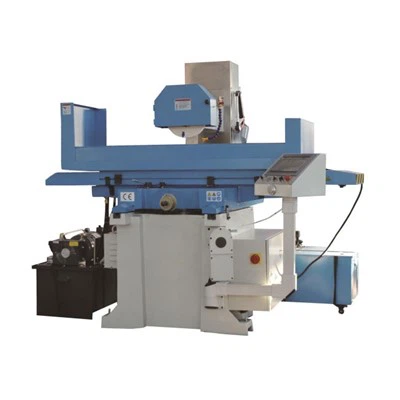
First, let’s start with the core parts of an automatic surface grinder that drive power use. The biggest consumer is the grinding spindle—this is the high-speed rotating part that holds the abrasive wheel and does the actual material removal. Spindle power depends on two key things: the size of the wheel (wider, larger diameter wheels need more torque to spin) and the material being ground. For example, grinding soft aluminum vs. hardened tool steel requires different cutting pressures, which change how much power the spindle pulls.
Next, there’s the hydraulic system, which is what moves the worktable back and forth, controls cross-feed movements, and adjusts the grinding depth. Most automatic surface grinders use hydraulic pumps that run at a consistent rate when the machine is active, even when there’s no grinding happening, so that’s a constant baseline draw. Then there are auxiliary components: the coolant pump (critical to keep the wheel cool and clear swarf), the filter system for recirculating coolant, the control panel and servo motors that manage automatic cycle functions, and even the machine’s lighting and enclosure fans.
To get a real sense of actual power use, let’s ground this in typical numbers from the machines we supply. Entry-level automatic surface grinders, sized for small to medium jobs (like grinding dies, mold components, or small metal parts), usually have a spindle motor rated between 2 and 5 horsepower (HP). When the machine is idling—running the hydraulic pump, coolant, and controls but not actually grinding—power draw sits between 1.5 and 3 kilowatts (kW). Once you hit a heavy grinding cycle, where you’re removing material at a consistent rate, that jumps up to 4 to 8 kW. For context, a standard residential water heater uses about 4.5 kW when active, so a grinder under heavy load is roughly equivalent to two water heaters running at once.
Mid-range automatic surface grinders, designed for higher volume work or tougher materials (like thick stainless steel or titanium parts), bump up the spindle power to 7.5 to 15 HP. Idle power here is slightly higher, between 2.5 and 4 kW, because the hydraulic system is built for heavier loads. Under full load, these machines pull between 9 and 18 kW. The top-tier industrial automatic surface grinders, used for large aerospace or automotive components, can have spindle motors up to 25 HP, with heavy-load power draw reaching 28 to 35 kW. That’s more power than most residential home circuits can handle, which is why these machines are hardwired into three-phase industrial power supplies.
But wait—those are rated or peak numbers. Actual real-world power use is almost always lower, because grinding is rarely a continuous heavy-load process. Most automatic surface grinders run in cycles: they move the table into position, take a few light passes, retract slightly to clear swarf, and adjust depth before the next pass. For example, a typical mold grinding cycle might be 50% idle time and 50% light grinding. That means average power use drops to 2 to 5 kW for entry-level machines, 4 to 10 kW for mid-range, and 12 to 20 kW for top-tier. That’s a big difference from peak numbers, and it’s why utility bills for grinding operations vary so much.
I see this play out with customers all the time. Last quarter, a job shop owner called me complaining his new automatic surface grinder was hiking his power bill 30%—but once we mapped out his actual usage, we saw he was running it 12 hours a day, 6 days a week, on heavy steel grinding. We suggested upgrading to a model with a variable frequency drive (VFD) for the spindle, which adjusts speed based on load instead of running at full RPM the whole time. That cut his average power use by 18% without sacrificing grinding speed or finish quality. VFDs are a game-changer for energy efficiency, and most modern automatic surface grinders we supply come standard with them now.
Another big factor that’s easy to overlook is how the machine is set up and maintained. A dull grinding wheel will require more power to push into material, because it’s not cutting as effectively. A wheel that’s not trued (aligned) correctly will vibrate, adding unnecessary load to the spindle. Even the coolant type matters: synthetic coolants reduce friction between the wheel and workpiece, cutting power draw by 5 to 10% compared to straight oil for many jobs. On the flip side, a clogged coolant filter makes the pump work harder, adding 10 to 15% to auxiliary power use. Regular truing, dressing, and filter changes aren’t just for better surface finish—they keep power costs low too.
Size and application also go hand in hand with power use. A small 6×12 inch automatic surface grinder for jewelry or small electronics parts will use less than a 10×20 inch grinder for automotive brake components. Material is the biggest variable, though: grinding titanium, which is strong and generates a lot of heat, can increase power draw by 20 to 25% compared to grinding aluminum, thanks to higher cutting pressures and the need for deeper passes.
Now, let’s talk about what this means for your operation. If you’re a small shop running 8 hours a day on light jobs, an entry-level 2 HP spindle grinder will cost you roughly $150 to $250 a month in power, depending on local utility rates. If you’re running two shifts a day on heavy steel, that jumps to $600 to $1,000 a month. For industrial users running 24/7, that number can go into thousands of dollars a month. That’s not a trivial cost, and it’s worth factoring into your machine purchase, not just the upfront price tag.
When we talk to customers, we always advise them to calculate their expected run time, material type, and part size before choosing a grinder. For example, if a shop is only grinding small parts occasionally, a smaller, lower-power model is better than an over-sized grinder that will run inefficiently at partial loads. For high-volume, heavy material jobs, investing in a model with a high-efficiency motor and VFD will pay for itself in lower power bills in 1 to 2 years, depending on usage.
I also want to address a common myth: some shop owners think more power equals better performance. That’s not always true. A grinder with a slightly lower spindle power but advanced control systems can remove material at the same rate as a higher-power model, because it’s optimizing pass depth and speed to avoid unnecessary load. It’s like comparing a car engine: a smaller, turbocharged engine can deliver the same acceleration as a larger, naturally aspirated engine while using less gas. The same logic applies here.
At the end of the day, power consumption for an automatic surface grinder isn’t a static number you can pull off a spec sheet. It’s a combination of machine design, setup, workload, and maintenance. As a supplier, my goal isn’t just to sell a grinder—it’s to help customers pick a machine that fits their needs, so they’re not overpaying for power or sacrificing performance. If you’re in the market for an automatic surface grinder, or you’re looking to upgrade your current setup to cut energy costs, I’d be happy to walk through your workload, material types, and run times to help you find the right solution. We’ve helped dozens of shops reduce their power bills while improving their grinding quality, and I can do the same for you. Don’t hesitate to reach out to start a conversation about your next grinder or how to optimize your current operation for lower energy use.
Precision Centerless Grinder References
- Groover, M. P. (2010). Fundamentals of Modern Manufacturing: Materials, Processes, and Systems (5th ed.). John Wiley & Sons.
- Todd, R. H., Allen, D. K., & Alting, L. (1994). Manufacturing Processes Reference Guide. Industrial Press Inc.
- American National Standards Institute (ANSI). (2018). Safety Standard for Machine Tools: Surface Grinders (B11.10-2018). ANSI.
- Hydraulic Institute. (2020). Energy Efficiency in Hydraulic Systems. Hydraulic Institute Publications.
Wuxi Mingxu Machinery Equipment Co., Ltd.
As one of the most professional automatic surface grinder manufacturers and suppliers in China, we’re featured by quality products and good price. Please rest assured to buy the best automatic surface grinder for sale here from our factory. Also, custom service is available.
Address: No. 5-5 Jinke Wealth Plaza, Changjiang North Road, Xinwu District, Wuxi City, Jiangsu Province
E-mail: yingyingmxjd@163.com
WebSite: https://www.mingxu-china.com/
