If you’ve ever stood next to a robotic arm precisely placing tiny electronics on a circuit board, watched a CNC mill carving delicate woodwork, or seen a 3D printer extrude filament layer by layer with near-perfect accuracy, you’ve witnessed two of the most common workhorses of industrial motion control: AC servo motors and stepper motors. As an AC servo motor supplier, I get asked this question at least a few times a week—usually from engineers weighing up upgrades, maintenance teams troubleshooting inconsistent performance, or small business owners outgrowing their original motor setup. The confusion is understandable: both motors move in discrete, controllable steps (or so it seems at first glance) and both show up in everything from factory automation to hobbyist equipment. But scratch past the surface, and their differences aren’t just technical—they’re foundational to how they operate, how they perform under pressure, and which tasks they’re built to master. AC Servo Motor
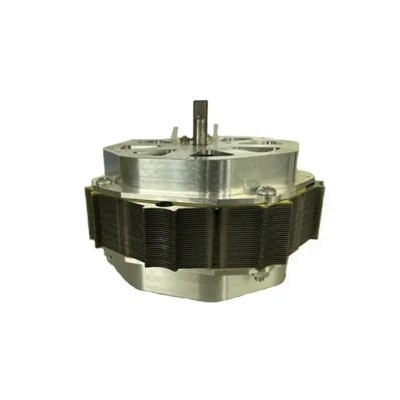
Let’s start with the most basic mechanics, because that’s where all other differences stem from. Stepper motors are, at their core, permanent magnet synchronous motors designed to rotate in fixed, equal-angle increments called steps. A typical NEMA 23 stepper, for example, moves 1.8 degrees per full step, meaning it will do 200 full rotations to spin a full 360 degrees. They don’t need an encoder to know where they are—you just send a pulse signal, and each pulse makes the motor jump exactly one step. No feedback, no checking, just open-loop control. That’s why they’ve been a staple in affordable, lower-precision equipment for decades: 3D printers, basic CNC routers, small conveyor belts, even the auto-adjustment mechanisms in some car seats.
AC servo motors operate on a different principle. Like steppers, they’re permanent magnet synchronous motors, but their design is built for continuous, smooth rotation rather than fixed steps. The key addition is a high-resolution encoder—usually 1,000 to 10,000 counts per revolution, sometimes even higher for precision applications—that constantly sends feedback to the motor driver. If the motor moves even a fraction less or more than it’s supposed to, the driver adjusts the voltage and current to correct it in real time. That closed-loop control is a game-changer for consistency, but it adds complexity and cost that steppers don’t have to deal with.
Next, let’s talk about performance, because that’s what actually matters for the jobs you’re paying these motors to do. The biggest myth about stepper motors is that they offer “perfect” positional accuracy because of their steps. In reality, their accuracy is relative to each step—1.8 degrees, for example, with a small deviation per step—but they have no way to confirm they landed where they should. If you overload a stepper—say, you ask it to move a load heavier than its rated capacity, or you accelerate too fast—the motor will skip steps, and you’ll never know. One second it’s placing a part where it should be, the next it’s off by 10 degrees, and you’ll only catch the mistake when the product comes off the line. That’s a costly flaw for high-volume manufacturing.
AC servo motors eliminate that entirely. The encoder is watching every microsecond—if there’s even a 0.1-degree deviation, the motor adjusts. They also deliver consistent torque across their entire speed range. Stepper motors, by contrast, have peak torque only at low speeds. Crank a stepper up to 1,000 RPM, and its torque drops off sharply; push it past that point, and it stalls completely. AC servos maintain their rated torque even at high speeds—perfect for applications that need both speed and power, like robotic arms lifting heavy payloads while moving quickly, or a machine tool spindle spinning at 5,000 RPM while cutting hard metal.
Noise and efficiency are other often-overlooked differences. Stepper motors make a distinct, high-pitched whine when running, especially at low speeds, because they’re constantly switching phases to hold position and move in steps. That whine can become a problem in environments where noise is a concern, like medical device manufacturing or office automation equipment. They’re also less efficient: a lot of the energy sent to a stepper is wasted as heat, especially when it’s holding a position under load. You’ll feel the motor get hot to the touch even when it’s not moving.
AC servo motors run much quieter, because their rotation is smooth and continuous—no discrete step changes creating vibration. Their efficiency is also far higher; most of the electrical energy is converted into motion, not heat, which means lower energy bills and less strain on the motor over time. That heat difference is a big one for industrial settings, where motors run 24/7. A stepper might need to be shut down periodically to cool, but a servo can run continuously without issue, as long as it’s sized correctly for the load.
Now, let’s get real about applications. Stepper motors still have a place—if you’re building a low-cost, low-precision 3D printer for a hobbyist, or a small lab device that only needs to move a few millimeters at a time, a stepper is more than enough, and it’s cheaper. But when precision, reliability, and speed matter, AC servos are non-negotiable. Think about automotive component manufacturing: placing tiny, fragile sensors onto a car’s dashboard requires positional accuracy of less than 0.05 millimeters, and a single mistake costs thousands in scrap parts. That’s a job for a servo. Or packaging lines: moving boxes at 100 per minute, each needing to be sealed in exactly the right spot. A stepper might struggle to keep up and maintain consistency, but a servo will do it all day without skipping a beat.
I’ve seen this play out firsthand in the dozen years I’ve worked as an AC servo motor supplier. A few years back, a small custom packaging company reached out to me because their new line of medical device blister packs was failing inspections. They’d been using stepper motors on their pick-and-place heads, and the packs were being sealed off-center 10% of the time. The steppers could move, but under load, they’d skip steps, and the line was running 18 hours a day. We replaced their steppers with compact AC servo motors, and the defect rate dropped to 0.1% overnight. Their output went up too, because they could run the line at a higher speed without sacrificing quality.
Another example: a CNC woodworking shop that was using stepper motors for their router. They were taking on custom furniture jobs that required smooth, curved cuts, and their steppers were leaving visible lines where the steps aligned, ruining expensive walnut and maple stock. Switching to servos eliminated those lines, they could handle tighter tolerances, and they started taking on high-end cabinet jobs they’d previously turned away because of quality limits. That’s the difference in action: steppers work for simple, forgiving tasks, but servos unlock new capabilities.
Cost is a factor, and I won’t pretend otherwise. A basic NEMA 23 stepper motor and driver might set you back $50 or $100. A comparable AC servo system—motor, encoder, driver, and wiring—will run $300 to $800. But you have to look at total cost of ownership, not just the upfront price. Servos are more efficient, so your electricity bill is lower. They last longer, because they don’t have the strain of operating at their torque limits and overheating. Most importantly, they reduce scrap and downtime, which are two of the biggest hidden costs in manufacturing. A single hour of downtime on a production line can cost thousands, and a week of high defect rates can wipe out the profit on an entire job. For businesses that rely on consistent output and quality, the higher upfront cost of a servo is almost always paid back within a year or two.
I also get asked a lot about maintenance. Stepper motors are simpler, so they’re easier to work on for small issues—you can adjust the step settings yourself, no special tools needed. AC servo motors have a few more components, like the encoder, so you need specialized tools to calibrate them, but they rarely need maintenance if they’re sized correctly and installed properly. I’ve had servo motors running 10 years without a single service call, while stepper motors in the same setting might need replacement every 2 to 3 years from heat damage or step skips.
Let’s wrap this up with what it all comes down to, because at the end of the day, choosing between the two isn’t about which is “better”—it’s about which fits your needs. If you’re building a hobbyist project, a low-volume lab device, or a setup where precision and speed aren’t the top priorities, a stepper motor will get the job done at a lower cost. But if you’re working in industrial automation, CNC machining, robotics, or any application where consistent accuracy, high speed, and reliability are non-negotiable, an AC servo motor is the way to go. It’s built to handle the demands of 24/7 operation, deliver the precision you need to avoid costly mistakes, and grow with your business as you take on more complex jobs.
As an AC servo motor supplier, I’ve seen too many businesses make the mistake of choosing a stepper to save a few dollars upfront, only to regret it when their setup can’t keep up with demand. That’s why I always take the time to walk through a client’s specific needs: what’s the load they’re moving, how fast do they need it to go, what level of precision is required, and how long will the motor run each day. No two applications are the same, and I don’t push a one-size-fits-all solution. The best motor is the one that works for your exact operation, not the cheapest one on the market.
If you’re currently troubleshooting a motion control setup, upgrading from older motors, or just curious about how AC servo motors can make your process more efficient, I’d love to chat. We can go over your current challenges, review what motor options would work best for your goals, and answer any questions you have about operation, maintenance, or pricing. There’s no obligation, just a chance to figure out what’s right for your business.
Permanent Magnet DC Moto References
- Bolton, W. (2015). Mechatronics: Electronic Control Systems in Mechanical and Electrical Engineering. Pearson Education Limited.
- Kinematic Technologies. (2022). “Stepper vs. Servo Motors: Performance, Efficiency, and Application Guide.” Industrial Motion Control Journal.
- Li, Y., et al. (2021). “Closed-Loop Control of AC Servo Motors for High-Precision Industrial Automation.” IEEE Transactions on Industrial Electronics.
- Precision Microdrives. (2020). “Motion Control for Consumer and Industrial Devices: Choosing Between Stepper and Servo Motors.” Engineering Practice Report.
- Valtchev, S. (2019). “Torque Characteristics of Stepper vs. AC Servo Motors at Variable Speeds.” International Journal of Machine Tools and Manufacture.
Zibo Auric Mechanical and Electrical Technology Co., Ltd.
As one of the leading ac servo motor manufacturers and suppliers in China, we warmly welcome you to buy advanced ac servo motor for sale here from our factory. All customized motors are with high quality and competitive price.
Address: B419, High-tech Entrepreneurship Park, High-tech Zone, Zibo City
E-mail: cui@auricmotor.com
WebSite: https://www.auricmotor.com/
